






MOGADISHU — A growing number of companies in Mogadishu are racing to obtain internationally recognized quality and management certifications, signalling a new phase in Somalia’s private sector development as businesses seek to improve efficiency, boost credibility, and compete in regional and global markets.
Across industries—from pharmaceuticals and telecommunications to banking, agriculture, and healthcare—Somali firms are increasingly adopting internationally recognized standards such as Quality Management Systems (QMS), Environmental Management Systems (EMS), Integrated Management Systems (IMS), Good Manufacturing Practices (GMP), and Food Safety Management Systems (FSMS).
Business leaders say the shift is driven by three major forces: the urgent need to improve operational efficiency, the expansion of regional economic integration across the Horn of Africa and East Africa, and the growing influence of globalization on supply chains and trade.
A New Benchmark for Somali Businesses
For decades, Somali companies largely operated outside the formal certification systems common in global markets. Today, however, firms are actively pursuing standards set by the International Organization for Standardization (ISO) and other international frameworks to align with global best practices.
Certification is no longer a luxury—it’s becoming a requirement,” said a Mogadishu-based industry consultant involved in quality management implementation. “Companies that want to export, attract international partners, or participate in regional trade must demonstrate that their systems meet international benchmarks.”
Companies Leading the Movement
Several Mogadishu-based firms have already achieved internationally recognized certifications or are in advanced stages of implementation.
Among the companies leading the transformation are:
Prime Pharma — A pharmaceutical manufacturer adopting GMP and QMS standards to ensure quality drug production.
Yenison — A manufacturing and distribution company strengthening operational management through ISO-aligned systems.
Banadiria Coffee — A growing coffee producer implementing FSMS and quality standards to access international markets.
SOM Tissue — A paper and hygiene products manufacturer improving efficiency through QMS and environmental compliance frameworks.
Hormuud Telecom — Somalia’s largest telecom operator integrating IMS to enhance service reliability and operational governance.
Salaam Somali Bank — A leading financial institution implementing quality and information management frameworks to strengthen banking operations.
Somali Sudan Company — An industrial firm pursuing international compliance standards in manufacturing and trade.
Greenlife Agribusiness — A food and agricultural enterprise adopting FSMS and sustainability-focused practices.
Kaarkaal Hospital — A healthcare provider aligning medical and administrative systems with quality management standards.
Hope Lab — A diagnostic laboratory improving testing accuracy and operational reliability through international quality systems.
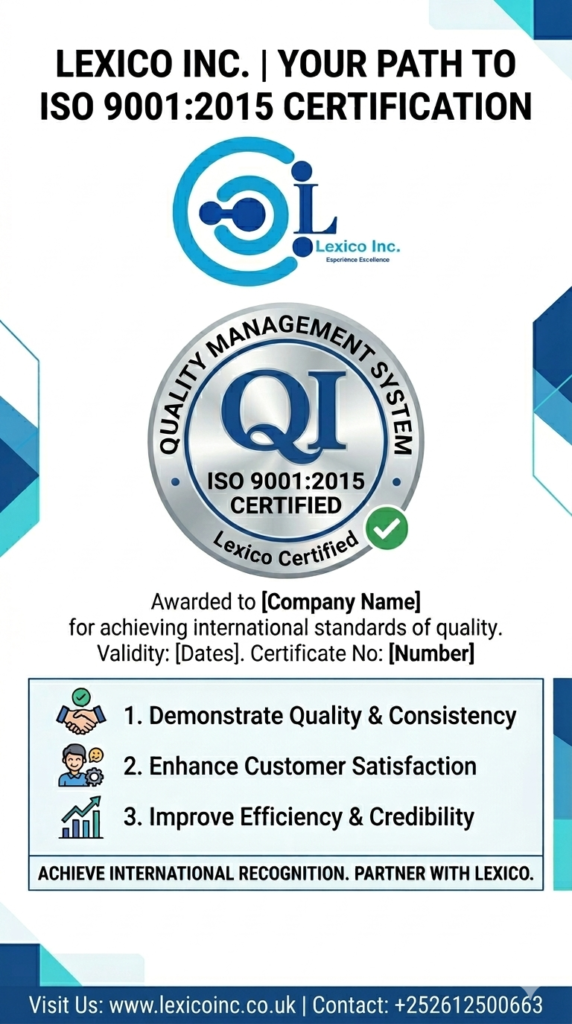
As the demand for certification grows, consulting firms are playing a crucial role in helping companies navigate the complex process of implementing international management systems. Among the firms supporting this transformation is Lexico Inc., a Mogadishu-based consultancy specializing in quality management systems and organizational development.
Industry observers note that Lexico Inc. has positioned itself not merely as a facilitator of certification, but as a partner in long-term institutional improvement.
The firm works closely with companies to design and implement management systems that align with international standards while fitting the operational realities of Somali businesses. Its approach emphasizes training, internal capacity building, and continuous improvement.
According to consultants familiar with the process, the company’s philosophy is that certification should not be treated as a symbolic achievement.
Obtaining the certificate is only the first step,” said a quality management advisor involved in several certification projects. “The real objective is to ensure that companies fully implement the systems, monitor their effectiveness, and maintain them over time.”
Through internal audits, staff training, performance monitoring, and management reviews, Lexico Inc. supports companies in embedding ISO principles into daily operations—ensuring that standards translate into measurable improvements in quality, efficiency, and accountability.
Efficiency and Competitiveness
Experts say that adopting ISO standards does more than enhance reputation—it often transforms how companies operate.
Quality management systems streamline workflows, reduce waste, improve documentation, and strengthen accountability within organizations. Environmental standards encourage sustainable operations, while food and pharmaceutical safety standards help protect consumers and build trust.
“Companies that implement these systems often see significant improvements in efficiency and productivity,” said a quality assurance specialist working with several Mogadishu firms. “It creates structure, discipline, and measurable performance indicators.”
Opening Doors to Regional Trade
Somalia’s gradual economic re-engagement with regional markets has also intensified the push toward certification.
As trade links expand with countries across East Africa and the Gulf, international buyers increasingly require standardized production and quality assurance.
For food exporters such as Banadiria Coffee and agribusiness firms like Greenlife, compliance with food safety standards is often essential for entering foreign markets.
Similarly, banks, telecom companies, and hospitals see certification as a way to align with international regulatory expectations and attract partnerships.
A Growing Trend
Analysts believe the movement toward international certification is still in its early stages but gaining momentum rapidly.
More Somali companies are expected to pursue ISO certification in the coming years as competition increases and investors demand higher standards of governance and transparency.
Business associations and consulting firms in Mogadishu report a steady rise in requests for training, auditing, and certification preparation.
Building Global Confidence
For Somalia’s private sector, the adoption of international standards represents more than compliance—it is a step toward rebuilding global confidence in Somali businesses after decades of economic disruption.
As more firms align themselves with global quality frameworks, experts say the country could strengthen its reputation as a competitive destination for trade, investment, and industrial growth.
“The companies taking this step today are setting the benchmark for the future,” the consultant said. “They are proving that Somali businesses can meet—and even exceed—international standards.”
— Lexico Press














Leave a comment